
The challenge: turning and lifting a skid in a very limited space
The project was carried out on a handling line at an automotive manufacturing plant, at a point where skids carrying vehicle bodies are transported.
The customer's requirement was to perform two consecutive operations:
- Turn the skid 90° at floor level.
- Lift it approximately 3 metres to subsequently transfer it to a handling line located at a higher level.
In a conventional installation, these two operations are performed using two independent stations. First, a standalone station turns the skid and, subsequently, a scissor lift table raises it to the upper line.
On paper, this is a common configuration. However, in this case there was a key constraint: there was virtually no space available to install both stations. An alternative was therefore required to perform both functions while occupying as little space as possible.
Application study: finding an alternative to the conventional solution
To address this requirement, the Heckert technical department jointly analysed the application and the specific conditions of the installation.
The conventional solution involved installing two independent pieces of equipment, but the available dimensions did not allow this to be implemented appropriately.
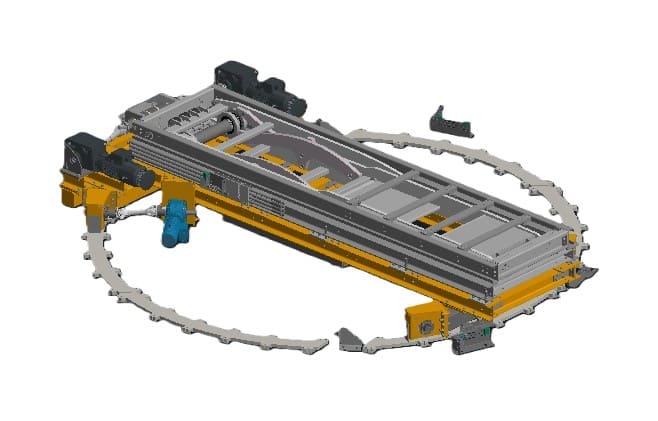
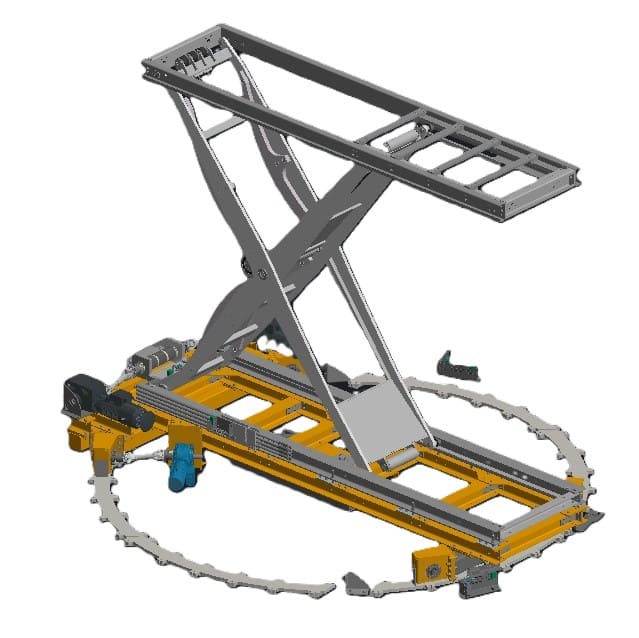
Therefore, a different concept was proposed: developing a special station capable of both turning the skid 90° and lifting it, achieving with a single piece of equipment the functions normally provided by two independent stations.
One station, two operations
The solution developed integrates the entire operating sequence:
Skid at floor level → 90° rotation → lifting approximately 3 m → transfer to the upper line
This eliminated the need for separate turning and scissor lift stations.
The result was a compact solution specifically designed for the installation's conditions, providing the space saving required by the customer.
A special application vs. a standard solution
One of the most relevant aspects of this project is that it did not rely on a standard market configuration.
Combining turning and lifting in a single station requires different engineering aspects to be taken into account, including load movement, overall dimensions, the inertia generated during rotation, structural loads and the movement sequence.
After analysing different alternatives, a specific solution was proposed to integrate both functions, thereby addressing one of the project's main limitations: performing the two required operations without the space that a conventional installation would require.
Space optimisation without compromising the production cycle
Reducing the required space was the main objective of the development, but the solution also had to meet the cycle times established for the line.
The system is designed to perform the operations according to the planned sequence:
- Turning the skid at a low height
- Lifting it to the upper line
- Transferring the skid to the next stage of the process
This sequence allows the required cycle time of the installation to be maintained.
In addition, the concept developed offers an additional opportunity for optimisation. If future production requirements called for a shorter cycle time, the possibility of performing the turning and lifting operations simultaneously could be studied.
This possibility would require a specific engineering study, particularly to analyse the inertia, loads and stresses generated during the combined movement, and to ensure that the system can perform both operations safely and reliably.
Therefore, the solution not only addresses the current requirement but also offers potential for future development and optimisation.
Engineering applied to real industrial requirements
This project demonstrates that, in certain industrial applications, the solution is not simply a matter of selecting two catalogue products. When significant space constraints exist, it is necessary to analyse the installation as a whole and consider how different functions can be integrated into a single piece of equipment.
In this case, the joint work between the customer, the Heckert technical department and Bamar Técnicas transformed a physical constraint — the lack of available space — into a special engineering project: a single station capable of performing two operations that would normally require independent equipment.
Bamar Técnicas: custom handling solutions
At Bamar Técnicas, we specialise in industrial supply and the development of solutions tailored to specific handling and industrial automation applications.
We work around the real requirements of each installation to find solutions for challenges that cannot always be addressed using standard components or systems.
This project is an example of our approach: analysing the application, understanding the installation's constraints and developing a specific technical solution when a conventional approach is not suitable.
Because in industry, when space is limited, engineering also means making two functions fit into the space of one.
Contact our technical team and let us assess your application.


